
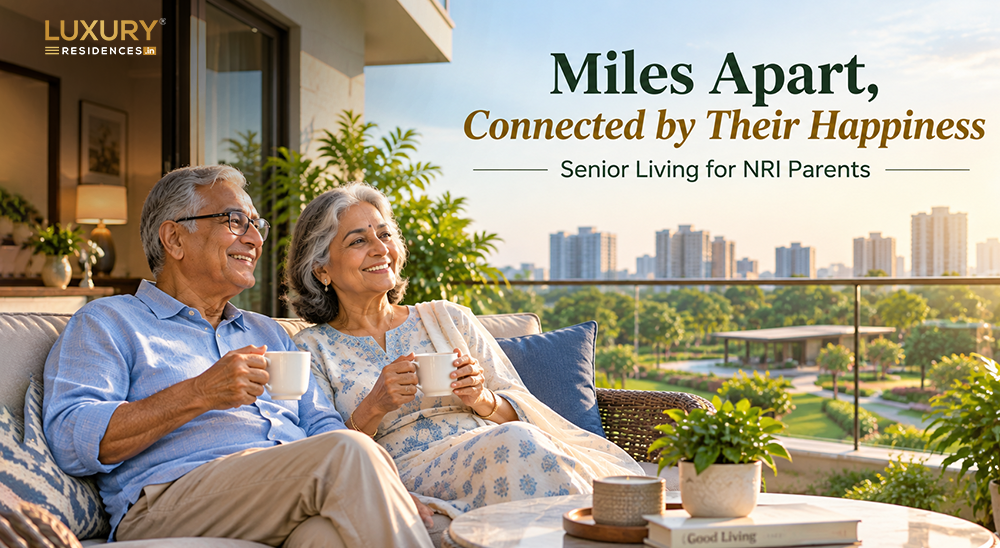
Miles Apart, Peace of Mind: Is Senior Living the Right Choice for NRI Parents?
For many Non-Resident Indians (NRIs), living abroad brings professional opportunities and a better lifestyle. However, being miles away from ageing parents in India can create a different set of concerns. While parents may continue living independently in their own homes, everyday responsibilities, healthcare requirements and the need for social interaction can become more challenging with age.
Regular video calls and occasional visits help families stay connected, but they cannot always replace immediate assistance when parents need it. This has encouraged many NRI families to explore Senior Living for NRI Parents as an alternative to conventional independent living.
Unlike traditional retirement arrangements, a modern senior living community aims to combine private residential spaces with access to healthcare support, security, social activities and professionally managed facilities.
Gurgaon is also emerging as an important destination for organised senior housing, supported by its healthcare infrastructure, residential developments and connectivity to Delhi and the international airport.
But is senior living genuinely a better alternative? And what should NRI families consider before choosing a senior living project?
Let’s explore the factors that can help families make an informed decision.
Understanding the Changing Needs of NRI Parents Living in India
The needs of older adults often change gradually. Parents who were comfortable managing their homes independently may eventually prefer having additional support with everyday responsibilities.
For NRI families, these changes can be difficult to manage because geographical distance limits their ability to provide immediate assistance.
Some common concerns include:
- Healthcare access: Regular medical consultations, health monitoring and emergency assistance may become increasingly important.
- Household management: Managing domestic staff, repairs, maintenance and everyday services can become inconvenient.
- Social interaction: Limited opportunities to meet friends and participate in community activities may affect social well-being.
- Emergency preparedness: Children living abroad may not be able to reach their parents immediately when an unexpected situation arises.
- Long-term arrangements: Families need to consider how living requirements may change over the next 10–15 years.
These concerns do not mean that older adults cannot live independently. Instead, they highlight the importance of having a reliable support system around them.
For many families, the objective is not to take away their parents’ independence but to make it easier and more comfortable to maintain.
Why Is Senior Living Becoming Important for NRI Families?
India’s ageing population is creating a growing need for organised senior housing.
According to JLL’s September 2026 report, India’s population aged 60 and above is approximately 166.9 million and is projected to reach 346 million by 2050.
At the same time, the organised senior housing market had approximately 25,050 units as of June 2026. This represents only around 1.5% penetration of the estimated addressable senior living market.
This difference between potential demand and organised supply highlights the opportunity for professionally managed senior living developments in India.
For NRI families, this changing market is particularly relevant because children increasingly live and work in different countries while their parents prefer remaining in familiar Indian surroundings.
A dedicated senior living community can provide an environment where older adults continue managing their daily routines while having access to support services within their residential surroundings.
What Makes Senior Living Different from Conventional Housing?
A conventional residential property primarily provides a place to live. A senior living project aims to address additional requirements associated with ageing.
| Factor | Conventional Residential Housing | Senior Living Community |
|---|---|---|
| Home management | Residents arrange household services | Community-level management may be available |
| Healthcare | Arranged independently | Medical support may be available within the community |
| Social interaction | Depends on neighbours and personal networks | Organised activities and shared spaces |
| Security | Depends on the building’s security arrangements | May include additional senior-focused safety systems |
| Daily assistance | Arranged separately | Services may be available depending on the project |
| Lifestyle | General residential environment | Designed around senior residents’ needs |
The actual facilities differ between developments. Families should examine the services included in the maintenance charges and distinguish between available facilities and services that require additional payment.
Senior Living vs Living Alone: Which Is More Suitable for NRI Parents?
Choosing between independent living and a senior living community depends on the parents’ health, preferences, lifestyle and available local support.
Living in their existing home may remain suitable for parents who have nearby relatives, reliable domestic assistance and convenient access to healthcare.
However, when children live abroad and local support is limited, a dedicated senior living environment may offer greater convenience.
Consider the following comparison:
| Important Consideration | Living Alone | Senior Living Community |
|---|---|---|
| Independence | Complete control over daily routines | Independence with optional support |
| Healthcare | Requires separate arrangements | May include on-site medical assistance |
| Social environment | Depends on existing social connections | Opportunities for regular interaction |
| House maintenance | Managed by residents or hired help | Professional facility management may be available |
| Emergency response | Depends on relatives, neighbours or emergency services | May include dedicated response arrangements |
| Lifestyle | Familiar surroundings | Activities and facilities designed for older residents |
| Family involvement | Children coordinate most arrangements remotely | Some everyday responsibilities may be managed locally |
The important distinction is the availability of support, not the level of independence.
Senior living is worth considering when parents want to continue making their own decisions but would benefit from having healthcare assistance, security and social interaction closer to home.
What Should NRI Families Look for in a Senior Living Project?
Choosing a senior living project requires more consideration than selecting a conventional residential property.
The property should support the parents’ present lifestyle while also addressing their potential future requirements.
Here are six important factors to evaluate.
1. Healthcare and Emergency Support
Healthcare arrangements should be among the first things families examine.
Check whether the development offers an on-site medical centre, nursing assistance, emergency response systems, ambulance arrangements and hospital tie-ups.
Also understand the limitations of these facilities. An on-site medical centre does not necessarily mean that specialist treatment or hospital admission is available within the residential complex.
2. Senior-Friendly Residential Design
The layout of a home can significantly influence everyday convenience.
Look for features such as:
- Step-free access wherever possible.
- Non-slip flooring.
- Wider internal passages.
- Convenient bathroom layouts.
- Accessible lifts and common areas.
- Emergency calling systems.
- Adequate natural light and ventilation.
These features can make everyday movement easier and reduce avoidable inconveniences.
3. Security and Emergency Management
A senior living community should have clearly defined security and emergency management arrangements.
Families should check entry controls, surveillance systems, staff availability, emergency contact procedures and the process followed when a resident requires assistance.
It is equally important to understand how the management communicates with family members during emergencies.
4. Social Activities and Community Interaction
Retirement should not mean giving up an active social life.
Shared recreational spaces, fitness activities, cultural programmes, hobby groups and community events can help residents maintain regular social connections.
Families should evaluate whether the community offers meaningful opportunities for interaction rather than simply providing recreational facilities.
5. Maintenance and Professional Management
A residential community requires consistent management.
Check who handles housekeeping, maintenance requests, security, common areas, repairs and service complaints.
For NRI families, a clearly defined management structure can reduce the need to coordinate everyday household issues from another country.
6. Future Healthcare and Care Requirements
Independent senior living and assisted living serve different requirements.
Parents who currently manage their daily activities independently may prefer an independent living arrangement. However, their future needs could change.
Families should understand whether the community offers additional assistance, what services are available, and whether residents can continue living there if their care requirements increase.
Why Is Gurgaon Becoming a Preferred Destination for Senior Living for NRI Families?
Location plays an important role when selecting a senior living community.
Gurgaon offers several advantages for families whose parents want to remain in North India while staying connected to major healthcare and transportation facilities.
Here are some reasons why the city deserves consideration.
1. Access to Multi-Specialty Healthcare
Gurgaon has established healthcare institutions offering a range of medical services.
Hospitals such as Medanta – The Medicity, Fortis Memorial Research Institute and Artemis Hospital provide access to specialist consultations and advanced medical facilities.
For older residents, proximity to healthcare can make routine consultations and planned hospital visits more convenient.
However, families should also evaluate actual travel times from the selected property and the availability of emergency transportation.
2. International Airport Connectivity
Gurgaon benefits from its road connectivity to Indira Gandhi International Airport in Delhi.
This is particularly relevant for NRI children who frequently travel to India to visit their parents.
Choosing a residential location with convenient airport access can make family visits and unexpected travel arrangements easier.
3. Established Residential Infrastructure
Areas along Golf Course Road and Golf Course Extension Road have developed into established residential and commercial corridors.
These locations offer access to shopping destinations, restaurants, daily conveniences and other urban facilities.
For older residents, being close to essential services can reduce dependence on long-distance travel for everyday requirements.
4. Familiarity and Social Connections
Many NRI families originally belong to Delhi NCR.
Moving parents to Gurgaon may allow them to remain close to existing relatives, friends and familiar social surroundings.
This can make the transition to a new residential community easier than moving to an unfamiliar city.
Understanding the Senior Living Supply in India: What Does It Mean for Buyers?
The senior living supply in India remains relatively limited compared with the potential demand.
JLL and the Association of Senior Living India reported approximately 25,050 organised senior housing units as of June 2026.
The market also continues to evolve from basic retirement accommodation towards more organised developments offering independent living, assisted living and integrated healthcare services.
This creates three important considerations for homebuyers.
Limited organised supply: Not every residential development offers dedicated senior-focused infrastructure. Buyers should distinguish between conventional housing with senior-friendly amenities and purpose-built retirement housing.
Importance of professional management: The quality of a senior living community depends not only on its construction but also on how effectively its services are managed after residents move in.
Long-term suitability: Families should evaluate whether a project can accommodate changing lifestyle and healthcare requirements rather than focusing only on its current facilities.
Therefore, when comparing retirement homes in Gurgaon, buyers should examine the developer’s experience, project approvals, service arrangements and long-term maintenance structure.
DLF The Aureva: Exploring DLF’s First Dedicated Senior Living Project in Gurgaon
As organised senior housing develops in India, established real estate developers are also entering this segment.
DLF The Aureva is one such development, located in Sector 63, Gurugram, along Golf Course Extension Road.
Positioned as DLF’s first dedicated senior living project, it is planned as a retirement housing development rather than a conventional residential apartment project.
The development is particularly relevant to NRI families looking for a residential property in India that addresses the requirements of senior residents.
DLF Aureva Gurgaon: Project Overview
| Project Detail | Information |
|---|---|
| Project Name | DLF The Aureva |
| Developer | DLF |
| Location | Sector 63, Golf Course Extension Road, Gurugram |
| Project Type | Retirement Housing |
| Land Area | Approximately 4.17 acres |
| Number of Towers | 1 |
| Residential Units | 172 |
| Commercial Units | 4 |
| Configuration | 4 BHK + Staff Dormitory |
The project is registered with Haryana RERA under registration number RC/REP/HARERA/GGM/1092/824/2026/64, dated 14 September 2026.
Its registration classifies it as a retirement housing project under Haryana’s Retirement Housing Policy.
What Makes DLF The Aureva Relevant for NRI Parents?
When evaluating DLF Aureva Gurgaon, families should consider how its proposed residential and healthcare features relate to the everyday needs of older residents.
1. Dedicated Retirement Housing Development
Unlike a conventional apartment complex, DLF The Aureva is registered specifically as a retirement housing project.
This distinction is important because the development falls under a dedicated retirement housing framework.
2. Spacious Residential Layouts
The project offers 4 BHK residences with a staff dormitory.
For senior residents, spacious layouts can provide flexibility for family visits, personal activities and household assistance.
NRI children visiting India may also find additional space useful when staying with their parents.
3. Healthcare-Focused Planning
The reference project information describes an approximately 8,500 sq. ft. medical centre planned in association with Medanta.
For NRI families, the availability and operating scope of such a facility are important considerations.
Before making a decision, buyers should confirm the medical centre’s final specifications, staffing, operating arrangements and emergency services through the latest official project documents.
4. Location in Sector 63 Gurgaon
The project is situated in Sector 63 on Golf Course Extension Road.
This location provides access to the wider Gurugram residential and healthcare network, making it relevant for families evaluating senior living in Gurgaon.
5. A Dedicated Residential Environment
A purpose-built retirement housing development can offer a more focused residential environment for older adults.
However, families should assess the actual community facilities, accessibility provisions, security arrangements and services included in the project before deciding.
For NRI families, the most important question is whether the development can support their parents’ preferred lifestyle without making them feel dependent on others.
Can NRIs Buy a Residential Home in India for Their Parents?
Yes. NRIs and eligible Overseas Citizens of India (OCIs) can purchase residential property in India under the applicable FEMA regulations.
The Reserve Bank of India’s guidelines provide general permission for eligible NRIs and OCIs to acquire immovable property other than agricultural land, plantation property and farmhouses.
Some important considerations include:
- Property payments must be made through permitted banking channels.
- Payments can be made using eligible NRE, FCNR(B) or NRO account funds.
- Applicable property taxes, stamp duty and registration charges must be considered.
- Repatriation of residential property sale proceeds is subject to specific conditions, including the two-property limit where applicable.
NRI families should consult a qualified chartered accountant or legal professional before completing a transaction, particularly when deciding ownership arrangements between parents and children.
This is important because ownership can influence inheritance planning, taxation and the future transfer of the property.
How Can NRI Children Manage Their Parents’ Well-Being From Abroad?
Even when parents choose to continue living independently, NRI children can establish a structured support system.
Here are some practical measures:
- Maintain regular communication: Schedule calls at convenient times and discuss everyday requirements, not just major concerns.
- Build a local support network: Identify trusted relatives, neighbours or local contacts who can assist when required.
- Organise healthcare information: Keep medical records, prescriptions, doctor details and emergency contacts accessible to authorised family members.
- Arrange regular health check-ups: Help parents maintain relationships with local healthcare professionals.
- Plan emergency arrangements: Identify nearby hospitals, transportation options and people who can respond when family members are abroad.
- Discuss long-term living preferences: Involve parents in decisions about their future home and lifestyle.
A senior living community can simplify some of these arrangements, but it should not replace regular family involvement.
The best approach is to combine professional residential support with continued emotional connection and participation from children.
Conclusion: Choosing Peace of Mind Without Compromising Independence
For NRI families, choosing a suitable living arrangement for ageing parents is about balancing independence, safety, healthcare access and quality of life.
Living alone may remain a suitable choice when parents have a reliable local support network and are comfortable managing their daily responsibilities.
However, when family members live abroad and immediate assistance is difficult to arrange, a well-managed senior living community can offer a more organised alternative.
Gurgaon provides a relevant option because of its healthcare infrastructure, established residential locations and connectivity to Delhi’s international airport.
Developments such as DLF The Aureva in Sector 63 also reflect the growing focus on dedicated retirement housing in the city.
Ultimately, the right decision should be made with parents, not just for them. Their preferences, independence, comfort and future requirements should guide the choice.
After all, the objective of senior living is not simply to find a new home. It is to create an environment where parents can continue enjoying their lives while their children have greater confidence in the support available nearby.
FAQs: Senior Living for NRI Parents
1. Is senior living better than living alone for NRI parents?
Senior living can be a better option when NRI parents need regular social interaction, convenient healthcare access and local emergency support. It allows them to maintain independence while having community facilities and assistance nearby. However, the right choice depends on their health, preferences and existing support network.
2. What is the difference between senior living and retirement homes in Gurgaon?
Senior living generally focuses on independent residential living with senior-friendly facilities and optional support services. Retirement homes can include independent living, assisted living or full-time care arrangements. Families should check the healthcare facilities, daily assistance and service model before selecting a project.
3. Is it safe for elderly parents to live alone in India?
Yes, elderly parents can live safely on their own when they have suitable housing, reliable local contacts, access to healthcare and an emergency response plan. However, living alone without regular assistance can create challenges as healthcare and daily support requirements change with age.
4. Why is Gurgaon a good choice for senior living for NRI families?
Gurgaon offers access to multi-specialty hospitals, established residential neighbourhoods, shopping facilities and connectivity to Indira Gandhi International Airport. These advantages make it a practical location for NRI families who want their parents to remain in familiar surroundings while staying connected to essential services.
5. How can NRI children manage their parents’ care from abroad?
NRI children can arrange regular communication, local emergency contacts, scheduled health check-ups and accessible medical records. They can also consider a professionally managed senior living community that offers healthcare support, security and everyday assistance, depending on the parents’ requirements.
6. When is the right time for parents to move into senior living?
The right time is when parents begin considering additional convenience, social interaction or support but can still actively participate in the decision. Planning early allows them to evaluate different communities, understand available services and adjust to a new residential environment comfortably.
7. What is DLF The Aureva Sector 63?
DLF The Aureva is a dedicated retirement housing development by DLF in Sector 63, Gurugram, on Golf Course Extension Road. It is registered as a retirement housing project and comprises one tower with 172 residential units and four commercial units.
Explore More:
|
Luxury Apartments in Gurgaon |
|
|
Luxury Flats in Gurgaon |
|
|
Luxury Properties in Gurgaon |
|
|
Luxury Apartments on Golf Course Ext. Raod |
|
|
Luxury Projects in Sector 63 |
Related Posts:
- Senior Living Projects in Gurgaon: Where Freedom,…
- What Indian Investors Should Know Before Buying…
- Miami-Inspired Living: The Art of Bringing…
- Vastu Tips for Success and Fame in Life & Career
- Gurgaon Real Estate Market Trends & Outlook in 2026
- Mumbai Pune Expressway - Info, Route Map, Distance,…
- Sarjapur Projects in Bangalore: The Smart Choice for…
- Step-by-Step Process To Buying a House in Mumbai (2026)
- Can Indians Buy Property In Dubai
- Why Bangalore is Best City to Live in: Pros, Cons, and FAQs
- Delhi Master Plan 2047: What It Means for the Delhi…
- Virtual Property Tour : Benefits, Features & Smart…
- Golf Living in Gurgaon: The Story Behind the City’s…
- A Complete Guide of Living in Goa (Pros & Cons,…
- Top Under Construction Projects in Bangalore to…
- The Role of Vastu Shastra in Modern Architecture
- Bengaluru-Tughlakabad Freight Link Opens New Rail…
- Why AI Data Centers Could Be the Next Big Bet in…
- Bangalore Suburban Rail Project: How It Could…
- Property Investment in Yelahanka Becoming Next…
- The Significance of Dhanteras: Celebrating Wealth…
- New Launch Projects in Gurgaon (2026): Latest &…
- RERA vs HRERA Rules : Know The Rights and How to…
- 10 Main Door Design Ideas for Indian Homes
- Real Estate Market Size in India 2024- A Complete…
- Mumbai Real Estate: Investment Opportunities in 2026
- How to Invest in Real Estate India without Buying…
- Why Devanahalli Is the Future of Luxury Living in Bangalore
- Sobha Realty Dubai Event in Hyderabad 2026: Dates,…
- Top 10 Best Posh Areas to Live in Mumbai