
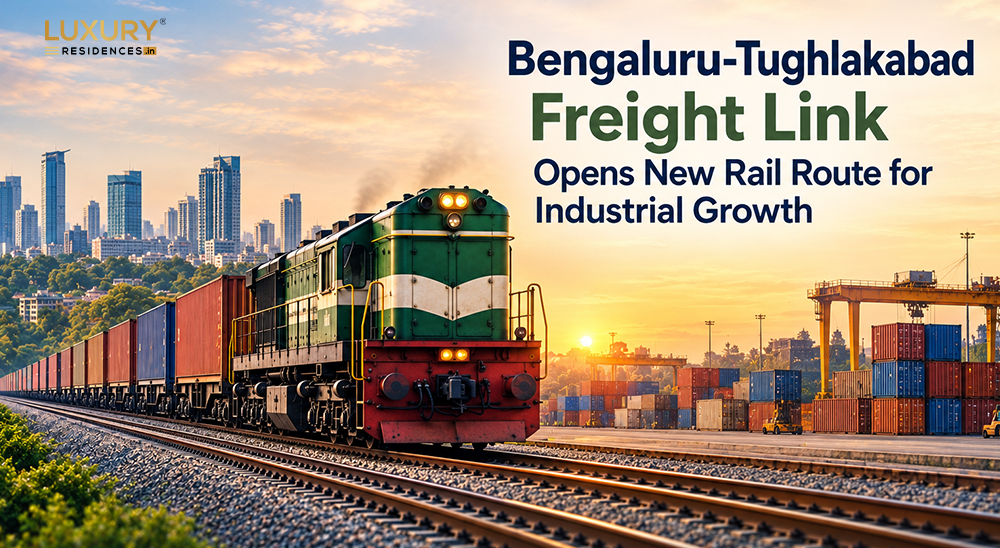
Bengaluru-Tughlakabad Freight Link Opens New Rail Route for Industrial Growth
A new railway route that connects Bengaluru and Delhi is now offering a new route for firms that wish to transport their goods through two of the most industrialised and commercial parts of India.
The Bengaluru-Tughlakabad freight link is scheduled to commence operations from September 2026 to connect ICD at Whitefield in Bengaluru to Tughlakabad in Delhi. This new weekly freight train service shall be operated jointly by the Container Corporation of India (CONCOR) and Indian Railways, and it offers an assured transit time of 166 hours, which is equivalent to seven days.
The significance of this new route for manufacturers, traders and logistics firms does not only lie in the fact that it is yet another route of freight train that will be connecting north and south. Rather, the advantage is that there is an option of scheduled rail transport.
It is envisaged that the Bengaluru-Tughlakabad freight train will run every Saturday and transport domestic cargo in CONCOR containers. It will cover a rail distance of approximately 2,500 km.
There is one other significant factor about the route as well. The cargo that leaves Bengaluru passes through the ICD of CONCOR at Tondiarpet in Chennai before being shipped further on its way to Tughlakabad. Thus, although the route is generally considered a freight link between Bengaluru and Delhi, in reality it is part of a larger logistics chain.
What is the Bengaluru Tughlakabad Rail Link?
The Bengaluru Tughlakabad rail link has been proposed to offer an on-schedule cargo train between Whitefield and Tughlakabad.
It would be helpful for Whitefield due to its positioning at the eastern part of Bengaluru, as well as its proximity to various industrial and manufacturing hubs around the outskirts of Bengaluru. After that, cargo could go by railway to the north and reach the market of Delhi NCR.
The on-schedule nature of the service is among its major benefits.
If we talk about a company transporting a consignment over 2,500 km, then knowledge of the exact time when the consignment would arrive would be almost as important as the reduction of the delivery time. Manufacturers could manage production and shipments, while distributors could deal with inventory and storage space.
Thus, the Bengaluru Tughlakabad freight service would give companies the very thing they always need: more predictability.
It does not mean that rail transport would replace trucks. They would still be used for cargo pick-up and delivery from the freight terminal to the destination point. But now companies have another opportunity to choose for the middle stage of their logistics supply chain.
How the Bengaluru-Delhi Freight Corridor Fits into the Picture
This rail link forms an additional link in the existing Bengaluru-Delhi freight corridor, which connects manufacturing activity in Karnataka with one of the largest markets for consumption and distribution in India.
Manufacturing and logistics operations extend much farther than the core city of Bengaluru. For example, manufacturing and logistics take place in many areas like Hoskote, Malur, Bommasandra, Peenya, Devanahalli, Tumakuru and other nearby zones.
The importance of the Bengaluru Tughlakabad rail link for these businesses will depend on how easily cargo can be transported to Whitefield or connected to the rest of the rail network. It matters because even though a freight terminal may provide great connectivity over distances, if moving a container from the factory to the terminal takes too much effort or money, the company may stick to road transportation.
Why Tughlakabad is an Important Destination
On the northern side of the route, we have Tughlakabad, which is a well-established freight and container logistics location for Delhi and the National Capital Region (NCR).
Delhi-NCR represents a significant market for companies based in Bengaluru. This region is where we find the buyers, retailers, wholesalers, businesses, and industrial customers from a large geographical spread.
From Tughlakabad onwards, road transport can carry freight to various parts of the Delhi-NCR and other northern markets.
It means that even companies whose final destination is not Delhi will benefit from the Bengaluru Tughlakabad freight train because they would use Tughlakabad as their gateway to a wide network.
A combination of rail transportation for long distance and road for local distribution seems likely to continue in the coming years. It means that rather than considering the choice between rail and road, we should consider the more realistic choice of road-rail-road.
Benefit to Bengaluru’s Industrial Areas
The inauguration of the Bengaluru-Tughlakabad rail freight service also affects Bengaluru’s industrial and warehousing sector.
An industrial firm usually seeks land, labour and road connectivity along with proximity to suppliers and logistical arrangements. Rail connectivity may also become one of the considerations for locating facilities such as plants, warehouses or distribution centres.
That is especially true for the eastern part of Bengaluru.
Whitefield and the larger Hoskote area already offer solid linkages within Bengaluru’s industrial network. The introduction of a scheduled rail service may make locations with rail access to the Whitefield ICD more favourable for firms that regularly send cargo to the North.
The coming of the new rail service does not necessarily mean an immediate increase in warehouse rents or the value of industrial properties. Effects of real estate are often lagging and depend on freight traffic volumes. The most beneficial properties would be those offering combined rail connectivity, good road connection, industrial activity and customer proximity.
Chennai’s Role Makes the Route Interesting
One thing that needs to be considered about the Tughlakabad rail link between Bengaluru is the involvement of Chennai in this transport system.
The shipment from Whitefield goes through the CONCOR ICD at Tondiarpet before being transferred for further shipping to Tughlakabad. This creates a wider logistics system covering the South rather than a straightforward Bengaluru-Delhi rail link.
This will make Chennai an important logistics aggregation and distribution hub. In addition, this shows how the Indian rail freight network operates, where one does not require a separate train service linking the shipment point to the end point.
Can the Bengaluru-Tughlakabad Freight Service Compete with Road Transport?
It is very likely to be the first question raised by businesses.
The flexibility of road freight remains an important one: a truck can pick up the cargo straight from the factory and bring it to the customer’s warehouse while there are additional terminal operations for rail transport.
Rail has its own comparative advantage. For long-distance, containerised cargo that follows certain schedules, rail offers an alternative to the full dependence on road freight.
In this regard, the 166-hour guaranteed transit time of the Bengaluru-Tughlakabad freight train becomes relevant. Companies have the opportunity to plan their logistics process using the schedule of the railway service instead of considering transit time as an unknown variable.
This includes the cost of factory pickup, transportation to Whitefield, loading into containers, rail freight, unloading and final delivery from Tughlakabad. In case the total cost makes rail transport comparable with road transport, there are good chances for regular clientele to attract.
For time-sensitive cargo, road transport remains the better choice. However, for regular containerised cargo, the Bengaluru-Tughlakabad freight service is a good option.
What This Means for India’s Freight Network
This development is especially crucial as efficient freight transport is becoming an increasing necessity for India’s manufacturing and distribution economy. An improved freight train network could play a useful role in linking manufacturing centres with consumption centres without relying heavily on roads for all the long-distance freight movement.
The Bengaluru-Delhi Freight Corridor is especially significant in this respect as it links India’s southern manufacturing base with the Delhi NCR market. But the new Bengaluru Tughlakabad freight corridor cannot be considered in isolation. It is its linkage to the rest of the railway network and industrial and transport links that adds value to it.
If industries use this facility consistently, the time may come when increased frequency and scheduled services would be justified. But this would depend on the demand generated by the industries.
What should businesses watch next?
It will definitely be interesting to observe how the Bengaluru Tughlakabad rail link performs in the initial period.
Firstly, this will be about the level of utilisation of the services provided. If the producers and retailers are constantly shipping full containers, this will mean demand, not just interest. Secondly, about reliability. It is important for the transit to be reliable and on time. Thirdly, about frequency. The once-a-week service is good, but later bigger businesses may require more departures per week. Lastly, the level of connectivity at the terminals will also affect the business model.
|
Luxury Villas For Sale in Bangalore |
|
|
Luxury Penthouses For Sale in Bangalore |
|
|
Luxury Apartments For Sale in Bangalore |
|
|
Luxury Flats For Sale in Bangalore |
|
|
Luxury Bungalow For Sale in Bangalore |
Related Posts:
- Griha Pravesh Muhurat in 2026: Dates & Month wise Timings
- Top Under Construction Projects in Bangalore to…
- The Significance of Dhanteras: Celebrating Wealth…
- Complete Insight on Bangalore Metro Map- Complete Route
- What Indian Investors Should Know Before Buying…
- Mumbai Metro Route 2026- A Complete Guide for Travellers
- Sarjapur Projects in Bangalore: The Smart Choice for…
- Bangalore Suburban Rail Project: How It Could…
- Top 12 Pink Two Colour Combinations for Bedroom Walls
- Top Real Estate Investment Trends To Know in 2026
- Gurgaon Real Estate Market Trends & Outlook in 2026
- Top 15 Best Places to Live in Mumbai
- Delhi Master Plan 2047: What It Means for the Delhi…
- National Highways – List of Total and Important…
- Real Estate Market Size in India 2024- A Complete…
- Mumbai Real Estate: Investment Opportunities in 2026
- Top 10 Biggest Malls in Mumbai- Your Next Stop for Shopping
- Top 20 Best Places to Live in Pune
- Vastu Tips for Success and Fame in Life & Career
- Step-by-Step Process To Buying a House in Mumbai (2026)
- Best 2026 Under Construction Projects Across Key Corridors
- A Complete Guide of Living in Goa (Pros & Cons,…
- Why Devanahalli Is the Future of Luxury Living in Bangalore
- All You Need To Know About Dwarka Expressway Gurgaon
- Top 10 Areas for Real Estate Investment in Chennai -…
- Why AI Data Centers Could Be the Next Big Bet in…
- Stamp Duty and Registration Charges in Thane 2026:…
- Property Investment in Yelahanka Becoming Next…
- New Launch Residential Projects in Mumbai in 2024
- Top 10 Best Posh Areas to Live in Mumbai